
Pushback: The Political Fallout of Unpopular Supreme Court Decisions
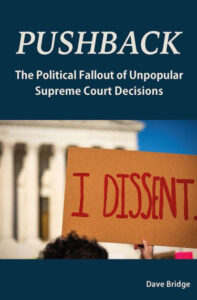 In this interdisciplinary book in an interdisciplinary series, Dave Bridge crosses methodological boundaries to offer readers insights on the political “pushback” that historically follows Supreme Court rulings with which most Americans disagree. After developing a framework for identifying the Court’s rare countermajoritarian decisions, Bridge shows how those decisions that liberals backed in the 1950s through the 1970s consistently upset conservative factions in the Democratic Party, which always managed to weather the storms—that is until Roe v. Wade in 1973. In Pushback, Bridge offers compelling hypotheses about how the two major parties can use unpopular Supreme Court rulings to shift the political momentum and win elections. He then puts those hypotheses to the test, analyzing the political fallout of recent rulings on controversial issues such as Obamacare, same-sex marriage, and religious liberty.
Certain to appeal to anyone interested in American political science and history, Pushback closes with a detailed examination of the unequivocally countermajoritarian Supreme Court ruling of our lifetimes, Dobbs v. Jackson Women’s Health Organization, which overturned Roe. For the first time in 50 years, conditions are ripe for a party to win votes by campaigning against the will of the Court. Upcoming elections will tell if the Republicans overplayed their hand, or if Democrats will play theirs as skillfully as did the GOP after Roe.
“An important and insightful contribution to our understanding of the Supreme Court’s role in American politics. A substantively rich account of the Warren and Burger Courts, and a theoretically valuable analysis of how the least democratic branch of the federal government is made to feel popular pressures.” —Keith E. Whittington, Princeton University
“Pushback offers the rare combination of rich history and sophisticated theory in exploring the ways in which the American people and governing officials respond to unpopular Supreme Court decisions. Scholars, political activists, and all interested readers have much to learn from Dave Bridge’s fascinating study of the successes, failures, and everything in between of political efforts to thwart judicial efforts to tell the rest of us what our Constitution means.” —Mark Graber, University of Maryland, Carey School of Law
Published:
University of Missouri Press, Studies in Constitutional Democracy Series, March 2024
Author:
Dave Bridge is an Associate Professor of Political Science at Baylor University
 Many new states entered the United States around 200 years ago, but only Missouri almost killed the nation it was trying to join. When the House of Representatives passed the Tallmadge Amendment banning slavery from the prospective new state in February 1819, it set off a two-year political crisis in which growing northern antislavery sentiment confronted the aggressive westward expansion of the peculiar institution by southerners. The Missouri Crisis divided the U.S. into slave and free states for the first time and crystallized many of the arguments and conflicts that would later be settled violently during the Civil War. The episode was, as Thomas Jefferson put it, “a fire bell in the night” that terrified him as the possible “knell of the Union.”
 The admission of Missouri to the Union quickly became a constitutional crisis of the first order, inciting an intensive reexamination of the U.S. Constitution by the U.S. Congress. The heart of the question in need of resolution was whether that body possessed the authority to place conditions on a territory—in this instance Missouri—regarding restrictions on slavery before its admittance to the Union. The larger question with which the legislators grappled was the limits of the Constitution’s provisions granting Congress the authority to affect the institution of slavery both where it already existed and where it could expand. The issue—what would come to be known as the Missouri Crisis—severely tested the still young republic and, some four decades later, would all but rend it asunder. This timely collection of original essays thoughtfully engages the intersections of history and constitutional law, and is certain to find eager readers among historians, legal scholars, political scientists, as well as many who call Missouri home.
 Many of the original essays in this volume began as papers presented at an international conference sponsored by the Missouri Humanities Council and the Kinder Institute on Constitutional Democracy, A Fire-Bell in the Past: Re-assessing the Missouri Crisis at 200, held at the University of Missouri at Columbia on February 15-16, 2019. In an attempt not only to reassess but add to historians’ understanding of the full scope of the causes and consequences of what came to be known as the Missouri Crisis, on a regional and national basis, the editors extended their invitation for scholarly works beyond the conference, ending up with too many first-rate and important new additions to the historiography than could be presented in this first volume. With the second volume slated for Fall 2021 publication, this unique work is perfectly timed to mark Missouri’s Bicentennial.
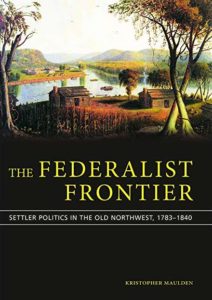 The Federalist Frontier traces the development of Federalist policies and the Federalist Party in the first three states of the Northwest Territory—Ohio, Indiana, and Illinois—from the nation’s first years until the rise of the Second Party System in the 1820s and 1830s. Relying on government records, private correspondence, and newspapers, Kristopher Maulden argues that Federalists originated many of the policies and institutions that helped the young United States government take a leading role in the American people’s expansion and settlement westward across the Appalachians. It was primarily they who placed the U.S. Army at the fore of the white westward movement, created and executed the institutions to survey and sell public lands, and advocated for transportation projects to aid commerce and further migration into the region. Ultimately, the relationship between government and settlers evolved as citizens raised their expectations of what the federal government should provide, and the region embraced transportation infrastructure and innovation in public education. Historians of early American politics will have a chance to read about Federalists in the Northwest, and they will see the early American state in action in fighting Indians, shaping settler understandings of space and social advancement, and influencing political ideals among the citizens. For historians of the early American West, Maulden’s work demonstrates that the origins of state-led expansion reach much further back in time than generally understood.
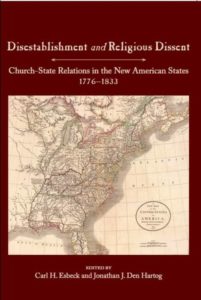 On May 10, 1776, the Second Continental Congress sitting in Philadelphia adopted a Resolution which set in motion a round of constitution making in the colonies, several of which soon declared themselves sovereign states and severed all remaining ties to the British Crown. In forming these written constitutions, the delegates to the state conventions were forced to address the issue of church-state relations. Each colony had unique and differing traditions of church-state relations rooted in the colony’s peoples, their country of origin, and religion. This definitive volume, comprising twenty-one original essays by eminent historians and political scientists, is a comprehensive state-by-state account of disestablishment in the original thirteen states, as well as a look at similar events in the soon-to-be-admitted states of Vermont, Tennessee, and Kentucky. Also considered are disestablishment in Ohio (the first state admitted from the Northwest Territory), Louisiana and Missouri (the first states admitted from the Louisiana Purchase), and Florida (wrestled from Spain under U.S. pressure). The volume makes a unique scholarly contribution by recounting in detail the process of disestablishment in each of the colonies, as well as religion’s constitutional and legal place in the new states of the federal republic.
 The Panic of 1819 tells the story of the first nationwide economic collapse to strike the United States. Much more than a banking crisis or real estate bubble, the Panic was the culmination of an economic wave that rolled through the United States, forming before the War of 1812, cresting with the land and cotton boom of 1818, and crashing just as the nation confronted the crisis over slavery in Missouri. The Panic introduced Americans to the new phenomenon of boom and bust, changed the country’s attitudes towards wealth and poverty, spurred the political movement that became Jacksonian Democracy, and helped create the sectional divide that would lead to the Civil War. Although it stands as one of the turning points of American history, few Americans today have heard of the Panic of 1819, yet we continue to ignore its lessons—and repeat its mistakes.
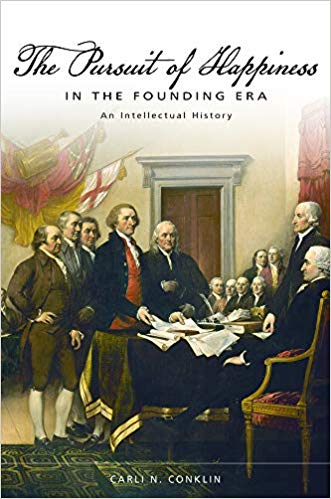 Scholars have long debated the meaning of the pursuit of happiness, yet have tended to define it narrowly, focusing on a single intellectual tradition, and on the use of the term within a single text, the Declaration of Independence. In this insightful volume, Prof. Carli N. Conklin considers the pursuit of happiness across a variety of intellectual traditions and explores its usage in two key legal texts of the Founding Era, the Declaration and William Blackstone’s Commentaries on the Laws of England.
 The idea that the three branches of the U.S. government are equal in power is taught in classrooms, proclaimed by politicians, and referenced in the media. But, as David Siemers shows, that idea is a myth, neither intended by the Founders nor true in practice. Siemers explains how adherence to this myth normalizes a politics of gridlock, in which the action of any branch can be checked by the reaction of any other. The Founders, however, envisioned a separation of functions rather than a separation of powers. Siemers argues that this view needs to replace our current view, so that the goals set out in the Constitution’s Preamble may be better achieved.
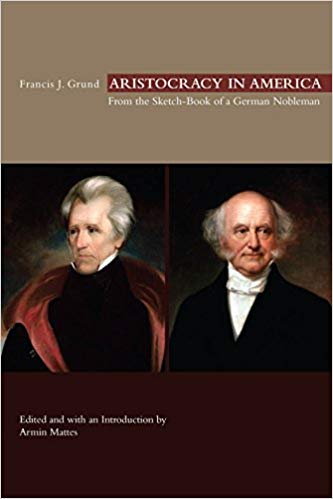 In Jacksonian America, as Grund exposes, the wealthy inhabitants of northern cities and the plantation South may have been willing to accept their poorer neighbors as political and legal peers, but rarely as social equals. In this important work, he thus sheds light on the nature of the struggle between “aristocracy” and “democracy” that loomed so large in early republican Americans’ minds.
 On December 4, 1865, members of the 39th United States Congress walked into the Capitol Building to begin their first session after the end of the Civil War. They understood their responsibility to put the nation back on the path established by the American Founding Fathers. The moment when the Republicans in the Reconstruction Congress remade the nation and renewed the law is in a class of rare events. The Civil War should be seen in this light.
 The U.S. Constitution requires laws to be made by elected representatives. Today, most policies are made by administrative agencies whose officials are not elected. Not coincidentally, many Americans increasingly question whether the political system works for the good of the people. In this trenchant intellectual history, Postell demonstrates how modern administrative law has attempted to restore the principles of American constitutionalism but has failed to be as effective as earlier approaches to regulation.
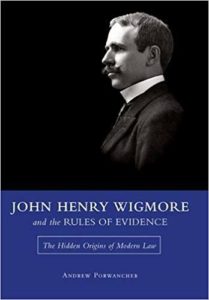 At the dawn of the twentieth century, the United States was reeling from the effects of rapid urbanization and industrialization. Time-honored verities proved obsolete, and intellectuals in all fields sought ways to make sense of an increasingly unfamiliar reality. The legal system, in particular, began to buckle under the weight of its anachronism. In the midst of this crisis, John Henry Wigmore, dean of the Northwestern University School of Law, single-handedly modernized the jury trial with his 1904-1905 Treatise on evidence, an encyclopedic work that dominated the conduct of trials. In doing so, he inspired generations of progressive jurists—among them Oliver Wendell Holmes, Jr., Benjamin Cardozo, and Felix Frankfurter—to reshape American law to meet the demands of a new era. Yet Wigmore’s role as a prophet of modernity has slipped into obscurity. This book provides a radical reappraisal of his place in the birth of modern legal thought.
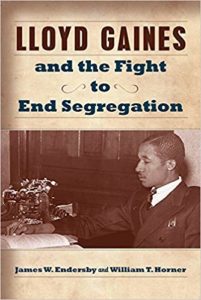 In 1935, Lloyd Gaines’ application to the University of Missouri Law School was denied, based solely on the grounds that the state’s constitution called for “separate education of the races.” Along with the NAACP, Gaines challenged the university’s admissions policies in the nation’s high court, and Missouri ex rel. Gaines v. Canada (1938) became the first in a long line of Supreme Court cases regarding race, higher education, and equal opportunity, and in many respects paved the way for 1954’s Brown v. Board. The case drew national headlines, and the NAACP moved Gaines to Chicago after he received death threats. Before he could attend law school, however, Gaines vanished, never to be seen or heard from again.