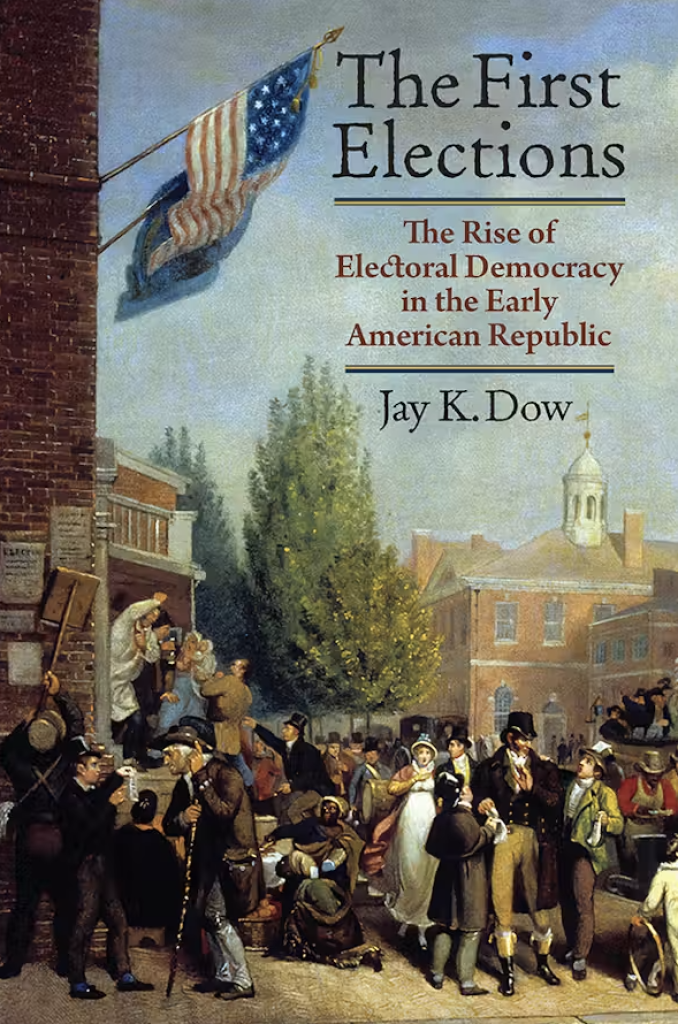
New Book Alert: Professor Jay Dow’s “The First Elections”
Page Content
The First Elections : The Rise and Fall of Electoral Democracy in Early America
June 9 will mark the publication of Kinder Institute and Truman School Professor Jay Dow’s second University Press of Kansas monograph on elections in early America, The First Elections: The Rise of Electoral Democracy in the Early Republic. We’ve included a description and select praise below, and join us in congratulating Prof. Dow on years of work at last finding their way to our bookshelves, and all interested can order your copy here.
In this groundbreaking and comprehensive look at Congressional elections in pre–Jacksonian America, Jay K. Dow examines the origins of our modern electoral politics.
When did the United States become a recognizably modern republic? The traditional understanding is that elections in the Age of Jackson introduced institutionalized political parties, campaigning, partisanship, position-taking, stump speeches, high elector turnout, and other familiar features of electoral democracy. Before that, so the story goes, elections were less organized along party lines, often uncompetitive, and frequently dominated by elites rather than average citizens. The First Elections offers a compelling alternative to this interpretation of the early American republic.
Through systematic analysis of an impressive new collection of early American election returns known as A New Nation Votes, Jay K. Dow has discovered what these results tell us about the development of Congressional elections between 1796 and 1825. The so-called first party era marks the transition from a “deferential” politics in which local elites exercised great influence over elections to a more recognizably democratic politics. But the extent of this transition has been largely opaque before these new data became available. Focusing on House of Representatives as the foundational institution in national republican government, Dow uses these election returns to provide a more fine-grained picture of US electoral development than ever seen before. In doing so, he reveals more party-centric, competitive, and developed elections than scholars have generally recognized.
The First Elections begins with the election to the Fifth Congress in 1796, the year that elections first became truly contested following the Federalist and Anti-Federalist period. It concludes with the elections to the Nineteenth Congress, which marked the start of the Jacksonian Second American Party System. Because American politics is territorial politics—in general, but especially in this era—Dow’s work is organized geographically, giving due attention to how electoral democracy developed unevenly across each region of the early United States. Since the states used different methods to elect their representatives, The First Elections pays special attention to the variety of electoral systems that characterized the political mosaic of early America.
The First Elections is a groundbreaking look at what elections were like in the dawn of the new American nation.
“In a stunning new interpretation of early American politics, Jay Dow explores the relationship between the growth of American democracy and the development of the first political parties. Drawing on a rich trove of newly available historical evidence, Dow shows how voter participation shaped the nature of party conflict in the first elections for Congress. Anyone interested in politics—past or present—will learn much from this book.”
—Rosemarie Zagarri author of Revolutionary Backlash: Women and Politics in the Early American Republic
“The First Elections shatters the myth that American political parties first took shape during the Jacksonian era. By closely analyzing elections in the House of Representatives, Dow convincingly demonstrates that a vibrant party system took shape in the late eighteenth and early nineteenth centuries. An engaging study that draws on the work of historians and political scientists, the book is a must-read for anyone interested in the origins and evolution of American political practices.”
—David W. Houpt, author of To Organize the Sovereign People: Political Mobilization in Revolutionary Pennsylvania